Key takeaways: FinFit loans vs. Kashable
- Both are employer-sponsored installment loans repaid through payroll — you need a participating employer for either.
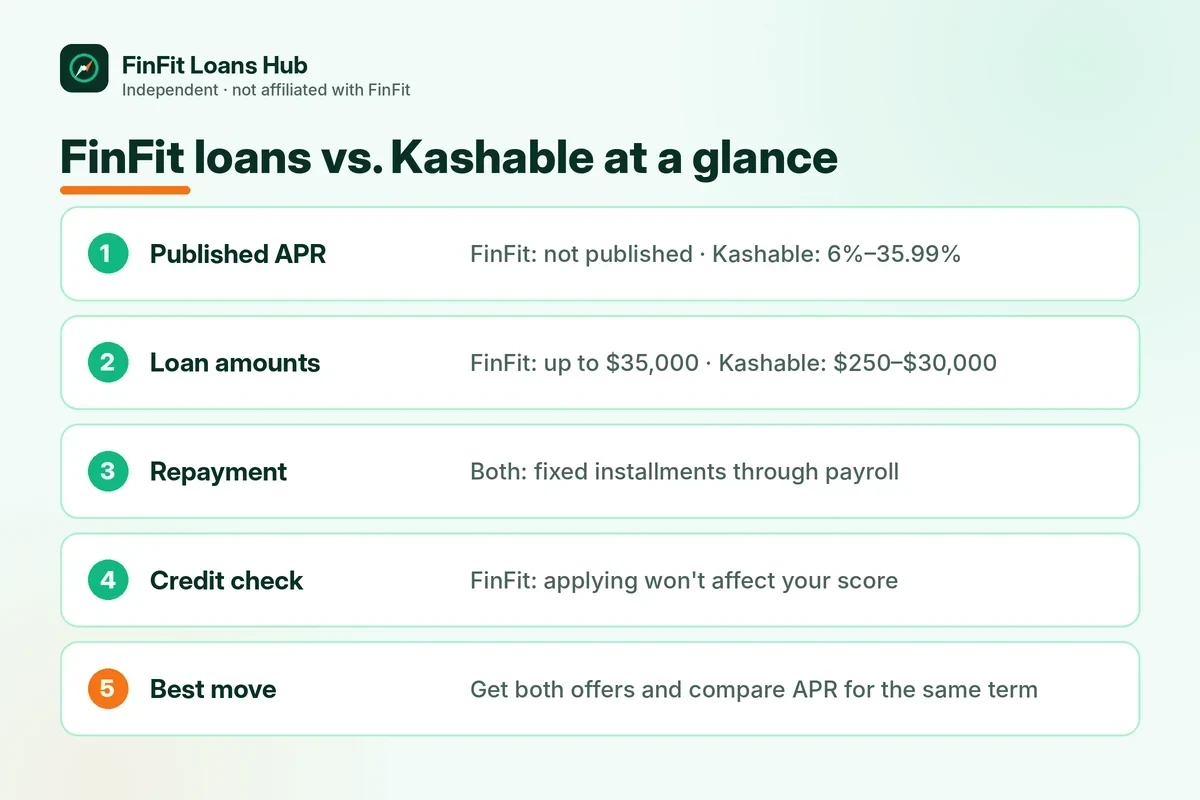
- Kashable publishes $250–$30,000 loans, 6–36 month terms, and a 6%–35.99% APR range; FinFit loans don’t publish an APR range.
- FinFit loans stand out for a credit-safe application, no prepayment penalty, and unchanged terms if you leave your job.
- If your employer offers both, get both offers and pick the lower APR for the same amount and term.
FinFit vs. Kashable: the quick overview
FinFit and Kashable solve the same problem: giving employees a safer alternative to payday loans, credit card debt, and 401(k) withdrawals. Both are employer-sponsored, both repay through payroll, and both are only available if your employer signs up. The biggest practical difference is how much they tell you before you apply.
- Kashable publishes its loan amounts ($250–$30,000), terms (6–36 months), APR range (6%–35.99%), and a worked example.
- FinFit publishes its process and protections in detail but no APR range; your fixed rate and all fees appear in your offer before you sign. Its personal loan is advertised up to $35,000.

FinFit vs. Kashable side by side
| Feature | FinFit loans | Kashable |
|---|---|---|
| Who can apply | Employees of participating employers | Employees of participating employers (and federal employees) |
| Lender | Celtic Bank | Lending partners named in your loan documents |
| Published APR | Not published; disclosed before signing | 6%–35.99% |
| Loan amounts | Personal loan up to $35,000; smaller emergency credit | $250–$30,000 |
| Terms | Not published | 6–36 months |
| Rate type | Fixed for the life of the loan | Fixed installments per example |
| Repayment | Payroll deduction, or debit card / check | Payroll deduction |
| Applying affects credit? | No; hard inquiry only if you accept | Check your offer terms |
| Prepayment penalty | None | Check your loan terms |
| If you leave your job | Same rate and schedule; payments from bank | Check your loan terms |
| Savings feature | SafetyNet emergency savings | Varies by program |
Based on each company’s published disclosures as of November 2026. Employer programs can change limits and features.
Cost and transparency
Kashable’s published example makes costs concrete: an 18-month, $5,000 loan with a 22.33% interest rate and a $225 origination fee has 37 scheduled payments of $160.64, for an APR of 28.50%. Notice how the fee pushes the APR well above the interest rate. That’s exactly why the CFPB recommends comparing APR, not interest rate.
FinFit doesn’t publish an equivalent example. It says rates are fixed, based on employment and credit history, and that every fee is disclosed before you sign. Since applying to FinFit doesn’t affect your credit score, the smart move is simple: get the actual FinFit offer and compare its APR directly.
Rule of thumb: compare APR first, then total of payments, then the payment amount. The lowest payment is often the most expensive loan if the term is long.
Amounts, terms, and flexibility
For bigger debt-consolidation needs, both cover large amounts — Kashable up to $30,000 and FinFit’s personal loan up to $35,000 — though your employer’s plan and your income will set the real ceiling. For small emergencies, Kashable starts at $250; FinFit offers smaller emergency credit through its SafetyNet program.
FinFit has a couple of rules to know: only one loan at a time, no joint applications, no refinancing of personal loans, and loans for personal, family, or household use only. On the flip side, FinFit lets you opt out of payroll deduction and pay by debit card, check, or money order.
Borrower protections and credit building
Both lenders report to the credit bureaus, so on-time payroll payments can help your credit. FinFit stands out on three protections it states clearly:
- Applying doesn’t affect your credit score.
- No fees or penalties for early repayment.
- If you leave your employer, your rate and schedule don’t change.
FinFit’s SafetyNet design is another differentiator: once your loan is repaid, the same deduction can roll into an emergency savings account. Read how FinFit SafetyNet works.
FinFit or Kashable: how to choose
- Only one is offered? Use that one and compare it with a credit union loan.
- Both are offered? Get both offers. Choose the lower APR for the same term, unless one has a protection you value more (like FinFit’s job-change continuity).
- You might leave your job soon? Read each contract’s separation terms carefully.
- Neither is offered? See what to do when your employer doesn’t offer FinFit or check partner-network options.
Worked example: what a $3,000 employer loan could cost
Because FinFit doesn’t publish an APR and Kashable publishes a wide range, the useful question isn’t “which brand is cheaper?” but “what will my offer cost?” Here’s how much APR matters on the same $3,000 loan repaid monthly over 12 months. These are illustrative calculations, not offers from either company.
| APR | Monthly payment | Total interest |
|---|---|---|
| 10% | $263.75 | $164.97 |
| 20% | $277.90 | $334.84 |
| 30% | $292.46 | $509.54 |
| 36% | $301.39 | $616.64 |
Standard amortization, 12 equal monthly payments, no fees. Payroll loans are often repaid every pay period, which changes the payment amount slightly but not the overall pattern.
The gap between a 10% and a 36% APR on this one loan is more than $450. That’s why it’s worth getting both offers when your employer offers both programs — and why you should compare the APR, not the payment. Notice that the monthly payments only differ by about $38, which makes the more expensive loan easy to overlook.
Don’t forget fees
An origination fee raises the APR above the interest rate. Kashable’s published example shows this: a 22.33% interest rate plus a $225 fee on $5,000 over 18 months produces a 28.50% APR. FinFit says all fees are disclosed before you sign, and expedited funding may cost extra — so check whether faster delivery is worth the added cost.
FinFit loans or Kashable: which fits your situation?
The right choice depends less on the brand and more on what you need the money for and how your offers compare. Use this as a starting point:
| Your situation | What to favor |
|---|---|
| Small emergency under $1,000 | The offer with the lowest APR and fees; FinFit’s emergency credit or a short Kashable term can both work |
| Consolidating card debt | The lower APR for the same term — and a payment that still fits your paycheck |
| You may change jobs soon | FinFit loans, because FinFit says your rate and schedule stay the same if you leave; check Kashable’s separation terms |
| You want to check without a credit hit | FinFit loans, since FinFit says applying doesn’t affect your score |
| You want published pricing upfront | Kashable, which publishes an APR range and a worked example |
Whichever you choose, read the APR, the finance charge, and the total of payments on the final disclosure. The full FinFit loans comparison adds credit unions, 401(k) loans, and earned wage access to the picture.
Questions to ask HR about FinFit loans and Kashable
- Which employer loan programs do we offer, and are the loan features turned on for my group?
- Does our company set its own loan limits or terms for either program?
- How are payroll deductions stopped when a loan is paid off?
- What happens to an open loan if I leave the company?
- Are there other benefits, like a hardship fund, that might cost less than borrowing?
Frequently asked questions about FinFit loans
Is FinFit cheaper than Kashable?
It depends on your offer. Kashable publishes 6%–35.99% APRs; FinFit doesn’t publish a range. Get both offers and compare the APR for the same loan amount and term.
Can I have FinFit and Kashable loans at the same time?
FinFit allows one FinFit loan at a time; it doesn’t say anything about loans from other lenders. Taking two loans at once can strain your paycheck, so borrow only what you can repay.
Do FinFit and Kashable check credit?
Yes, both consider credit as part of approval. FinFit says applying doesn’t affect your score and a hard inquiry only appears if you accept the loan.
What is the minimum Kashable loan?
Kashable’s published disclosures list loan amounts from $250 up to $30,000, with terms of 6 to 36 months.
Do FinFit loans have origination fees?
FinFit says loans may carry fees and/or interest and that every fee is disclosed before you sign. Kashable’s published example includes a $225 origination fee on a $5,000 loan. Compare the APR, which includes most fees.
Can an employer offer both FinFit loans and Kashable?
It’s possible for an employer to offer more than one financial wellness program. Ask HR which programs are available to you.
Sources (5)
- Kashable — Loan disclosures (kashable.com/disclosure)
- FinFit — Frequently Asked Questions (FinFit member FAQ, accessed November 2026)
- FinFit — Personal Loan / Debt Consolidation Loan page (accessed November 2026)
- Consumer Financial Protection Bureau — “What is APR and how should I use it?”
- 401(k) Specialist — “FinFit Launches Safety Net Solution”