Key takeaways: FinFit loans vs. earned wage access
- EWA gives early access to earned wages; FinFit loans are installment loans repaid over time.
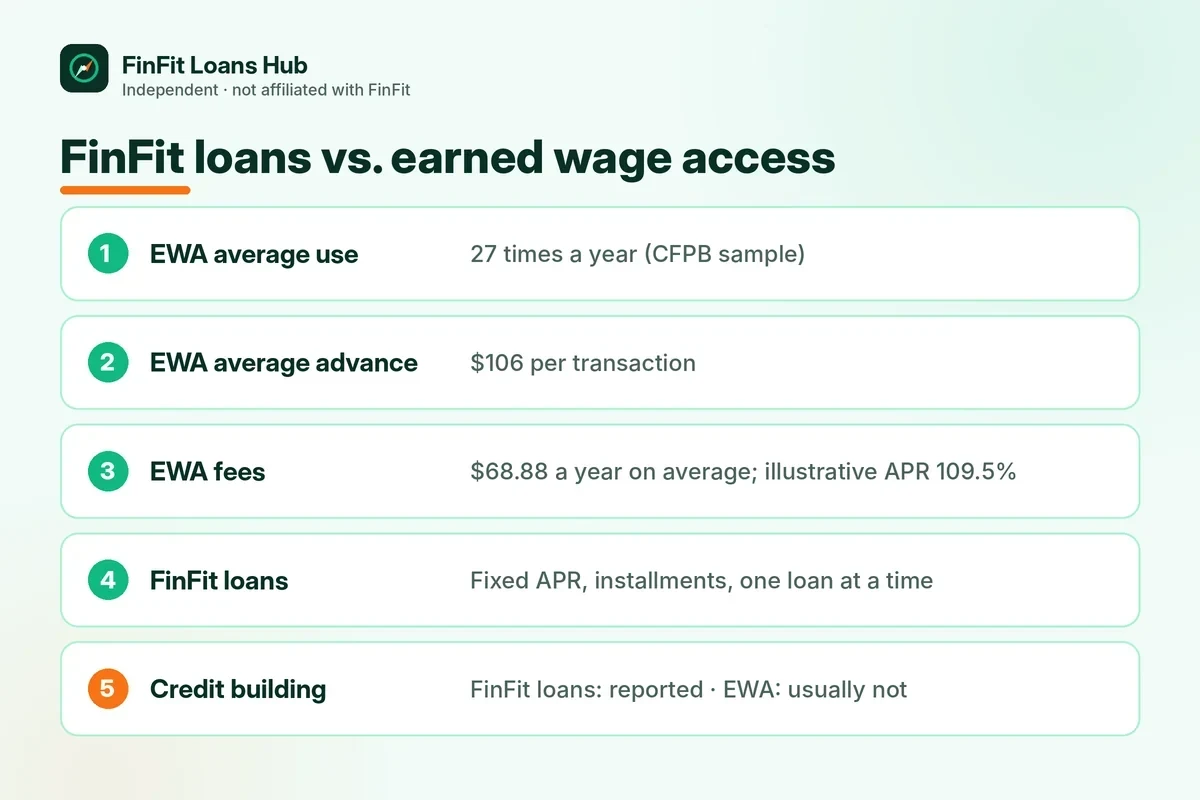
- CFPB data: 27 EWA uses a year on average, $106 per transaction, $68.88 a year in fees.
- The CFPB calculated an illustrative 109.5% APR for a typical employer-partnered EWA transaction.
- FinFit loans can build credit; EWA usually doesn’t.
The short answer
Earned wage access (EWA) can work for a small, one-time gap — especially if your employer covers the fees. FinFit loans are usually the better fit for a larger expense you need to repay over several paychecks, and they come with credit reporting that can help your score. The CFPB’s research on employer-partnered EWA shows the risk to watch: frequent, repeat use that adds up.

What earned wage access is
EWA products let workers access part of the wages they’ve already earned before payday. The amount is then taken back from the next paycheck. Some are offered through employers; others are direct-to-consumer apps. While employers can often make these programs fee-free, some come with fees for expedited service, subscriptions, or requested “tips.”
What CFPB data show about earned wage access
In a July 2024 data spotlight, the CFPB analyzed data from eight employer-partnered EWA providers. Key findings:
- The average worker in the sample used EWA 27 times a year.
- The average transaction was $106.
- When workers paid a fee, the average was about $3.18, and workers paid an average of $68.88 per year in fees.
- When employers didn’t cover costs, more than 90% of workers paid at least one fee, and most fee revenue came from expedited transfers.
- The CFPB calculated an illustrative APR of 109.5% for a typical employer-partnered EWA transaction.
A few dollars per transfer sounds small, but on a $106 advance repaid within days, it’s an expensive way to borrow — and 27 uses a year is close to one for every biweekly paycheck. In July 2024, the CFPB also proposed an interpretive rule addressing how paycheck advance products are treated under federal lending law.
FinFit loans vs. earned wage access: side by side
| FinFit loans | Earned wage access | |
|---|---|---|
| What you get | An installment loan from Celtic Bank | Early access to wages already earned |
| Typical size | Emergency credit up to personal loans of up to $35,000 | CFPB sample average: $106 per transaction |
| Repayment | Equal installments over multiple paychecks | Deducted from your next paycheck |
| Cost | Fixed APR disclosed before signing | Per-transfer or subscription fees; CFPB illustrative APR 109.5% |
| Builds credit | Yes, reported to bureaus | Usually not |
| Repeat-use risk | One loan at a time | CFPB sample average: 27 uses a year |
Sources: FinFit FAQ and personal loan page; CFPB July 2024 data spotlight. On mobile, swipe the table sideways.
When each option makes sense
Earned wage access may make sense when…
- You need a small amount for a few days.
- Your employer covers the fees, or you can wait for a free standard transfer.
- It’s a one-off, not a monthly habit.
FinFit loans may make sense when…
- The expense is larger than one paycheck can absorb.
- You need several pay periods to repay without creating a new gap.
- You want on-time payments to help build your credit.
How to use either one wisely
- Track every fee as if it were interest — because economically, it is.
- Avoid back-to-back advances. If you’re using EWA every paycheck, a structured installment loan or a budget reset may cost less.
- Plan the paycheck after. Both EWA and FinFit loans reduce future take-home pay; make sure essentials are still covered.
- Build a buffer. FinFit’s SafetyNet savings or a simple automatic transfer can end the cycle.
Don’t have FinFit or EWA at work? See 7 smarter ways to borrow.
What a $3.18 earned wage access fee really costs
A few dollars sounds trivial, which is exactly why it’s worth doing the math. Using the CFPB’s averages:
- A $3.18 fee on a $106 advance is 3% of the amount you received.
- If that advance is repaid in about 10 days, the annualized cost works out to roughly 109.5% APR — the same illustrative figure the CFPB reported.
- Because many workers use EWA repeatedly, small fees accumulate: the CFPB found workers paid an average of $68.88 a year in fees.
By comparison, FinFit loans disclose a fixed APR before you sign, spread repayment over multiple paychecks, and report on-time payments to the credit bureaus. For anything larger than a small, one-time gap, that structure usually costs less and builds more.
Breaking the earned wage access cycle
The CFPB’s finding of 27 uses a year points to a common pattern: an advance shrinks the next paycheck, which creates the next shortfall, which leads to the next advance. To break it:
- Total your last three months of advances and fees. Seeing the number is often enough to change the habit.
- Cover one pay period’s gap with a single, structured solution. If your employer offers FinFit loans, a small installment loan can replace a string of advances.
- Turn the old advance amount into savings. Once you’re no longer repaying advances, move that amount into an emergency fund automatically.
- Use free standard transfers instead of paid instant ones when you do use EWA.
Employer-paid vs. fee-based earned wage access
Not all EWA costs the same. The CFPB notes that employers can often make these programs fee-free, but some carry fees for expedited service, subscriptions, or requested tips. If your employer covers the cost and you use it rarely, EWA can be a reasonable bridge. If you’re paying for instant transfers every pay period, compare that ongoing cost with FinFit loans or a credit union loan — and with the cheapest option of all: a small emergency fund.
Questions to ask before you use earned wage access
- Who pays the fee? If your employer covers it, the cost may be zero. If not, ask what standard and instant transfers cost.
- Is there a subscription? Monthly fees add up even in months you don’t use the service.
- Are “tips” requested? Treat any tip as part of the cost.
- How will my next paycheck look? Subtract the advance and fees, then check that essentials are still covered.
- Is this a one-time gap? If you expect to need help again next pay period, a structured option like FinFit loans or a credit union loan may cost less.
Asking these five questions turns a quick tap in an app into an informed choice — and helps you spot when a different tool would serve you better. For a broader comparison of options, see FinFit loans vs. alternatives.
Frequently asked questions about FinFit loans
Is earned wage access cheaper than FinFit loans?
Not necessarily. CFPB data show a typical employer-partnered EWA transaction carries an illustrative APR of 109.5% when fees are paid. FinFit loans have a fixed APR disclosed before you sign, so compare the actual costs.
Does earned wage access build credit?
Usually not. FinFit loans report repayment history to the credit bureaus, which can help your score with on-time payments.
How often do people use earned wage access?
In the CFPB’s July 2024 sample, the average worker used employer-partnered EWA 27 times a year.
Can I use earned wage access and FinFit loans together?
Possibly, if your employer offers both, but stacking advances and loans reduces future paychecks. Make sure your take-home pay still covers essentials.
What are EWA fees usually for?
According to the CFPB, most fee revenue came from expedited transfers. Some programs also charge subscriptions or request tips.
Sources (4)
- Consumer Financial Protection Bureau — Data Spotlight: Developments in the Paycheck Advance Market (July 2024)
- Consumer Financial Protection Bureau — Proposed interpretive rule on paycheck advance products (July 2024)
- FinFit — Frequently Asked Questions (FinFit member FAQ, accessed November 2026)
- FinFit — Personal Loan / Debt Consolidation Loan page (accessed November 2026)