Key takeaways: are FinFit loans legit?
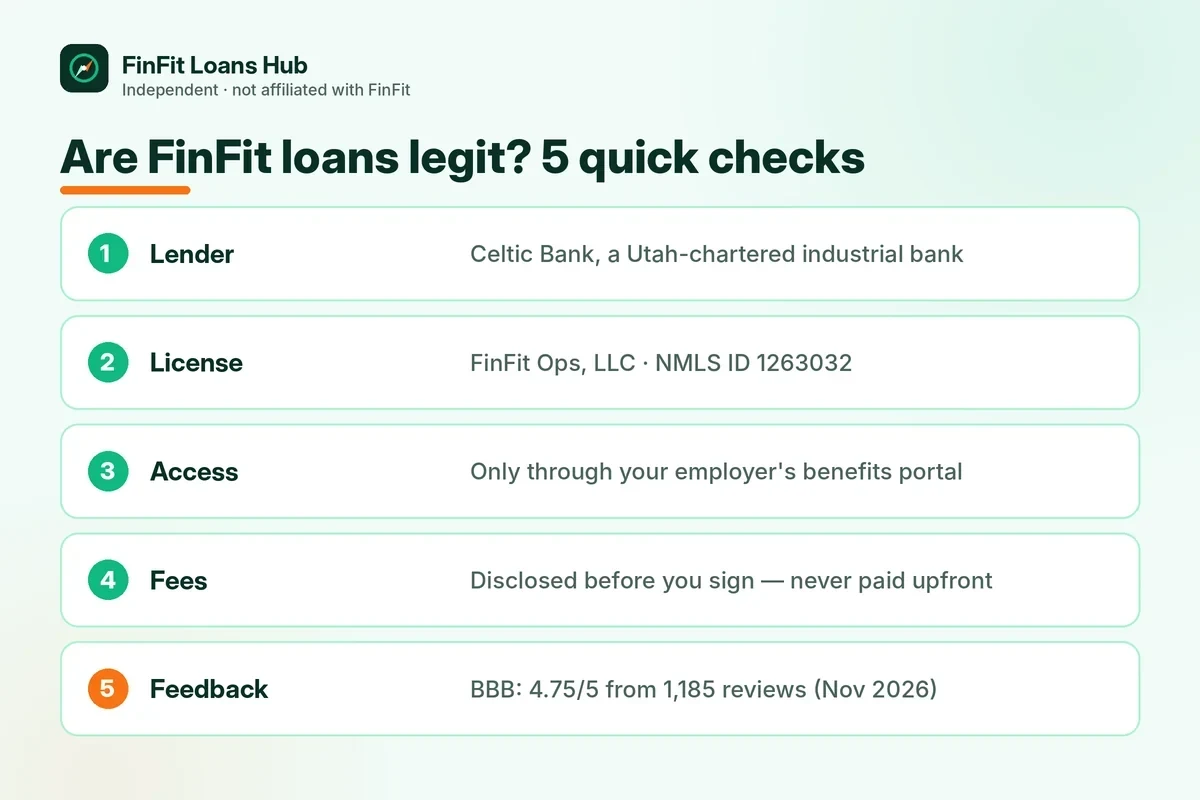
- Yes — FinFit loans are made by Celtic Bank, a Utah-chartered industrial bank, through an employer benefit FinFit has run since 2008.
- FinFit Ops, LLC publishes NMLS ID 1263032, state licenses, and state-specific consumer disclosures.
- The BBB profile for FinFit, LLC showed 4.75 out of 5 from 1,185 reviews when we checked in November 2026.
- Real FinFit loans start in your employer’s benefits portal — never from a cold call, text, or upfront fee.
The short answer: yes, FinFit is a legitimate employer benefit
FinFit is a real, established financial wellness company that employers offer as a workplace benefit. It has served employers since 2008, is headquartered in Virginia Beach, Virginia, and its loans are made by Celtic Bank, a Utah-chartered industrial bank. Its servicing company, FinFit Ops, LLC, publishes NMLS ID 1263032 and lists state licenses.
“Legit” and “right for you” are different questions, though. A legitimate loan can still be expensive or a poor fit. So let’s look at both: whether FinFit is trustworthy, and how to make sure your specific loan is a good deal.
Important: FinFitLoans.com is an independent guide, not FinFit. Real FinFit loans are only offered through participating employers. If someone contacts you out of the blue offering a “FinFit loan,” be cautious — more on that below.

Who is behind FinFit loans
Understanding who does what helps you know where to turn if something goes wrong.
- FinFit runs the employee financial wellness platform: education, assessments, dashboard, savings, and the loan application experience.
- Celtic Bank is the lender. FinFit’s FAQ is explicit that FinFit itself is not the lender.
- FinFit Ops, LLC and its affiliate Salary Finance, Inc. are the service providers. Salary Finance U.S. merged with FinFit in April 2023, and the combined company kept the FinFit brand.
- Your employer makes the benefit available and, in most cases, processes the payroll deductions that repay the loan.
This “bank partner” model is common in fintech lending. It means your loan contract is with a federally insured, state-chartered bank, while a technology company handles the experience. It also explains why products and features vary by state: lending laws differ, so the available loans differ too.
Licensing, disclosures, and regulation
Legitimate lenders make their licensing and disclosures easy to find. FinFit publishes a state licenses page, its NMLS number, and state-specific documents — including a New Mexico small loan consumer brochure and rate and fee disclosure, a South Carolina consumer rights notice, and a Vermont notice clarifying that FinFit Ops, LLC is not the lender.
Those documents also show the kind of guardrails that apply. FinFit’s New Mexico disclosure notes that state law caps APRs at 36% on loans over $500 up to $10,000, lists late fees and processing fees as “not applicable,” and tells borrowers they can request the completed disclosure for their specific loan. That’s the behavior of a regulated lender, not a fly-by-night operation.
One honest critique: FinFit doesn’t publish an APR range or a representative loan example on its main pages. You’ll see your rate before you sign, but you can’t comparison-shop beforehand. Competitor Kashable, by contrast, publishes a 6%–35.99% APR range. It’s not a legitimacy problem, but it’s a transparency gap worth knowing.
What FinFit customers actually say
When we checked the Better Business Bureau profile for FinFit, LLC in November 2026, it showed an average customer review rating of 4.75 out of 5 from 1,185 reviews. Recurring themes in positive reviews:
- Fast, simple application inside the benefits portal
- Help covering emergencies like medical bills, car tags, moves, and travel for family emergencies
- Appreciation that on-time payroll payments helped their credit
The negative reviews are just as useful, because they tell you what to watch:
- Deductions after payoff: one borrower described payroll deductions continuing for weeks after the loan was paid off, with a slow refund.
- Slower funding: a long-time user said funding that used to take under 24 hours took 3–5 days after FinFit’s partnership with another company.
- Limit cuts: a borrower reported a lower credit line despite on-time payments.
None of these suggest FinFit isn’t legitimate, but they show where to stay alert. See our full FinFit loans review for our scored verdict.
Red flags: how to spot FinFit imposters
Because FinFit is a recognizable name, scammers may borrow it. Real FinFit loans follow a predictable path, so anything off that path is a warning sign:
- Unsolicited calls, texts, or social messages offering a guaranteed FinFit loan. FinFit works through your employer’s benefits portal.
- Upfront fees to “release” or “insure” your loan. Legitimate lenders disclose fees in the contract; they don’t ask for gift cards, crypto, or wire transfers first.
- Requests for your login or one-time codes. No legitimate representative needs your password.
- Guaranteed approval. FinFit loans are subject to credit approval.
- Login pages at odd addresses. Reach FinFit only through the link your employer provides.
If you think you’ve been targeted, stop contact, don’t send money, and report it to your HR department, the FTC, and the CFPB.
Your 6-point FinFit safety checklist
- Start from your employer’s HR or benefits portal, not a search ad or a message.
- Confirm the lender named in your agreement is Celtic Bank.
- Read the APR, finance charge, payment amount, and number of payments before signing.
- Compare that APR with at least one other option, like a credit union.
- Save your signed contract and payoff confirmation.
- After payoff, check your next two pay stubs to confirm deductions have stopped.
If your employer doesn’t offer FinFit, you can’t get a real FinFit loan — but you can explore other options safely.
What to do if something goes wrong with your FinFit loan
Even with a legitimate lender, mistakes happen — a deduction that doesn’t stop, a payment that isn’t credited, or a disclosure you don’t understand. Work through this escalation path in order, and keep notes with dates, names, and screenshots at every step.
- Check your documents first. Pull up your signed loan agreement, your payment history in the FinFit dashboard, and your last few pay stubs. Many issues are timing problems between payroll cycles.
- Contact FinFit’s Account Management team. FinFit’s FAQ lists [email protected]. Describe the issue, the amounts, and the pay dates involved, and ask for a written response.
- Loop in HR or payroll. If deductions are the problem, your payroll team can confirm what instruction it received and when it was changed.
- Remember who the lender is. Celtic Bank is the lender on FinFit loans; your agreement names it and explains how to send disputes or complaints.
- Escalate to regulators if needed. You can submit a complaint to the Consumer Financial Protection Bureau online or by calling (855) 411-2372, and you can contact your state’s financial regulator or attorney general.
Refund tip: if you were charged after payoff, ask for the refund amount and expected date in writing, and confirm the deduction is removed before your next pay period closes.
A company’s response to problems tells you as much about its trustworthiness as its marketing does. That’s one reason our FinFit loans review scores customer experience separately from cost and speed.
Real FinFit loans vs. look-alike offers: side by side
Because FinFit is a recognizable brand, the safest way to judge an offer is to compare it with how real FinFit loans actually work. If anything in the right-hand column sounds familiar, stop and verify before you share information or money.
| Real FinFit loans | Warning signs of an imposter | |
|---|---|---|
| How it starts | You open FinFit from your employer’s HR or benefits portal | Someone contacts you first by phone, text, or social media |
| Who lends | Celtic Bank, named in your loan agreement | Lender name is missing, vague, or changes |
| Approval | Subject to credit approval | “Guaranteed approval, no matter what” |
| Fees | Disclosed in the contract before you sign | Upfront fee by gift card, wire, crypto, or payment app |
| Your login | You keep it private | They ask for your password or one-time code |
| Repayment | Payroll deduction or your own debit card/check | Pressure to pay a personal account or third party |
On mobile, swipe the table sideways to see both columns.
What legitimate FinFit loans never do
Knowing the boundaries of a real program makes scams easier to spot. Based on how FinFit describes its process, legitimate FinFit loans will not:
- Bypass your employer. Access is tied to your employer’s participation, so there’s no “direct” FinFit loan for people whose job doesn’t offer it.
- Skip the disclosure. You see your fixed rate, any fees, and the payment schedule before you sign.
- Charge you to apply. Applying doesn’t affect your credit score, and there’s no fee to check your offer.
- Penalize early payoff. FinFit states there are no fees or penalties for paying early.
- Let you hold two loans at once. FinFit allows one loan at a time, so an offer for a “second FinFit loan” while one is open deserves a hard look.
Still unsure? Our independent FinFit loans review scores the program on transparency, speed, and borrower protections.
Frequently asked questions about FinFit loans
Is FinFit a scam?
No. FinFit is an established employer benefit provider, and its loans are made by Celtic Bank. However, scammers may impersonate well-known brands, so only access FinFit through your employer’s benefits portal.
Who owns FinFit?
FinFit merged with Salary Finance U.S. in April 2023 and kept the FinFit brand. FinFit Ops, LLC and Salary Finance, Inc. are the service providers; Celtic Bank is the lender.
Is FinFit regulated?
Yes. FinFit Ops, LLC lists NMLS ID 1263032 and state licenses, and publishes state-specific consumer disclosures. The lender, Celtic Bank, is a Utah-chartered industrial bank.
Can I get FinFit loans from a phone call or text?
No. Real FinFit loans are accessed through your employer’s HR or benefits portal or the official FinFit link your employer provides. Treat unsolicited loan offers using the FinFit name with caution.
Where can I complain about FinFit loans?
Start with FinFit’s Account Management team, then your HR or payroll department. You can also contact Celtic Bank as the lender, submit a complaint to the CFPB online or at (855) 411-2372, or contact your state financial regulator.
Are FinFit loans available in every state?
No. FinFit says product availability and features vary by state, and it publishes state licenses and state-specific disclosures. Your FinFit dashboard shows what’s available where you live.
Sources (8)
- FinFit — Frequently Asked Questions (FinFit member FAQ, accessed November 2026)
- FinFit — Financial Wellness Program homepage and lending disclosures (accessed November 2026)
- FinFit — New Mexico Loan Rate & Fee Disclosure (accessed November 2026)
- Yespress — “The Brief: FinFit” (Salary Finance U.S. merger, SafetyNet launch)
- G2 — FinFit company profile
- Better Business Bureau — FinFit, LLC customer reviews profile (Virginia Beach, VA)
- Kashable — Loan disclosures (kashable.com/disclosure)
- Consumer Financial Protection Bureau — Submit a complaint
More guides on FinFit loans

How to Access FinFit Loans Through Your Employer (and What to Do If You Can’t)
Read article →
FinFit Loans vs. Kashable: Which Employer Loan Is Better?
Read article →