Key takeaways: FinFit loans vs. payday loans
- Payday loans commonly cost $15 per $100 — almost 400% APR on a two-week loan.
- FinFit loans are fixed-rate installments repaid over several paychecks, not one lump sum.
- Borrowing $500 at 36% APR over six months costs about $54 in interest vs. $75 for one on-time payday loan.
- FinFit loans can build credit; payday loans usually don’t.
The short answer: FinFit loans are usually far safer
If your employer offers FinFit, FinFit loans are almost always a better choice than a payday loan. You get a fixed rate, installments spread over multiple paychecks, credit reporting that can help your score, a credit-safe application, and no prepayment penalty. A payday loan, by contrast, is typically due in full on your next payday and often costs about $15 for every $100 borrowed — which the CFPB notes equals an APR of almost 400% on a two-week loan.

How FinFit loans and payday loans work
FinFit loans
FinFit loans are installment loans offered as an employee benefit. Celtic Bank is the lender. You apply through your employer’s FinFit portal, see your fixed APR and any fees before signing, and repay in equal installments, usually deducted from each paycheck. Contracts signed before 4 p.m. ET on a business day are funded by ACH the same day.
Payday loans
Payday loans are short-term loans, often for $500 or less, that are generally due on your next payday. Lenders typically charge a flat fee per $100 borrowed. If you can’t repay in full, many borrowers renew or “roll over” the loan, paying another fee while the original balance stays the same.
FinFit loans vs. payday loans: cost comparison
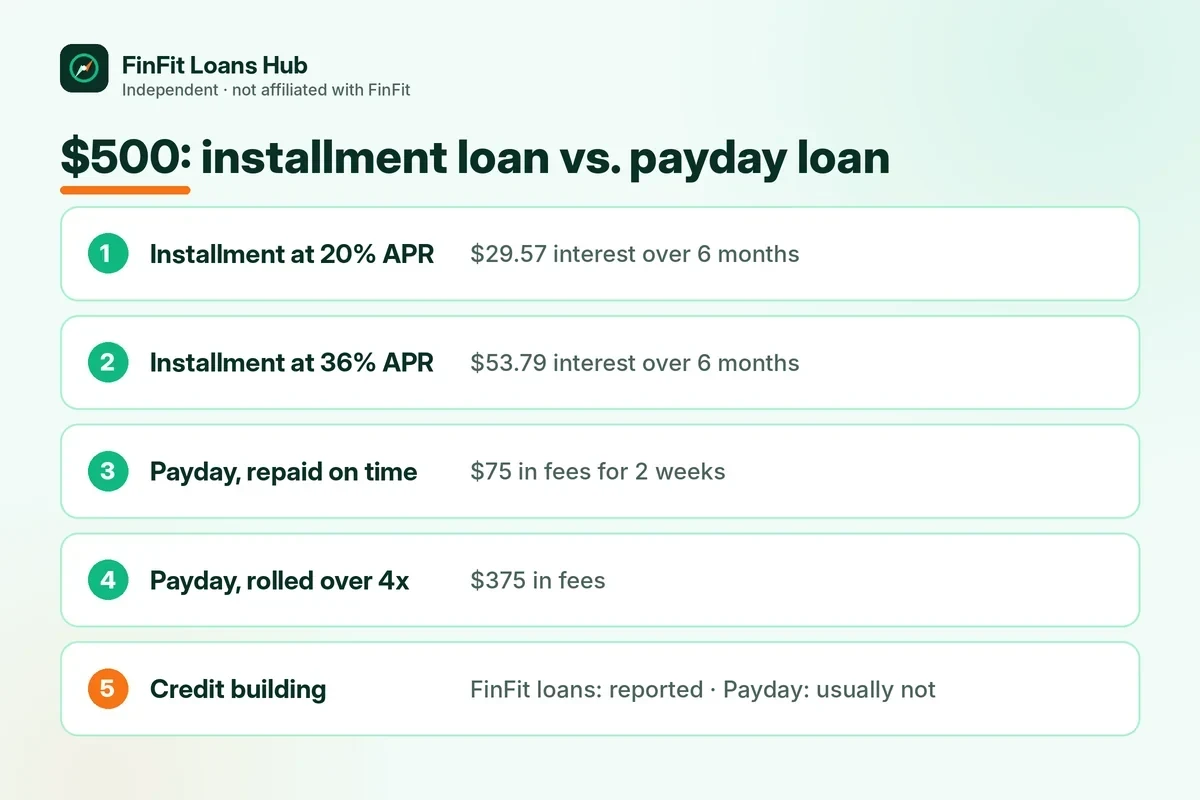
Here’s what borrowing $500 could cost in each case. These are illustrative calculations, not offers. FinFit doesn’t publish an APR range, so we show two example APRs for an installment loan.
| Scenario | How it’s repaid | Total cost of borrowing |
|---|---|---|
| Installment loan at 20% APR | 6 monthly payments of $88.26 | $29.57 in interest |
| Installment loan at 36% APR | 6 monthly payments of $92.30 | $53.79 in interest |
| Payday loan, repaid on time | $575 lump sum in two weeks | $75 in fees |
| Payday loan, rolled over twice | Fee paid three times, then $500 | $225 in fees |
| Payday loan, rolled over four times | Fee paid five times, then $500 | $375 in fees |
Payday figures use the CFPB’s common example of $15 per $100 per two-week period. Installment figures use standard amortization with no fees. On mobile, swipe the table sideways.
Even the more expensive installment example costs less over six months than a single on-time payday loan — and the gap widens quickly with every rollover.
The rollover trap that FinFit loans avoid
The real danger of payday loans isn’t the first fee; it’s the lump-sum due date. Paying back $575 from one paycheck often leaves a new shortfall, so the borrower renews and pays another fee without reducing the balance. FinFit loans are built the other way around: each installment pays down principal, so the balance shrinks every pay period. When the loan ends, FinFit’s SafetyNet design lets the same deduction keep going into savings — here’s how that works.
Credit impact: FinFit loans vs. payday loans
- Applying: FinFit says checking your offer doesn’t affect your score. Payday lenders vary.
- Building credit: FinFit reports repayment history to the credit bureaus; payday loans usually aren’t reported unless they go to collections.
- Risk of damage: a defaulted payday loan sent to collections can hurt your credit; FinFit’s payroll repayment makes missed payments less likely.
When a payday loan feels tempting, try this first
- Check your benefits portal for FinFit loans or another employer program.
- Call the biller and ask for a payment plan or a short extension.
- Visit a credit union about a payday alternative loan, capped at 28% APR.
- Compare installment offers by APR. If you don’t have FinFit, you can check options from our partner network.
For a broader view, see our full FinFit loans vs. alternatives comparison.
Example: a $400 car repair, two paths
To make the difference concrete, here’s the same $400 emergency handled two ways over about two months. These are illustrative calculations, not offers.
Path A: a payday loan that gets rolled over
At the CFPB’s common example of $15 per $100, a $400 payday loan carries a $60 fee every two weeks. If the borrower can only afford the fee on payday and rolls the loan over three times, they pay the fee four times — $240 in fees — and still owe the full $400 at the end.
Path B: an installment loan like FinFit loans
The same $400 repaid over four monthly installments at a 36% APR costs about $30.44 in interest, with payments of $107.61. At a 20% APR, interest drops to about $16.80. Every payment reduces the balance, and on-time payments with FinFit loans are reported to the credit bureaus.
The difference: roughly $240 in fees versus $17–$30 in interest for the same $400 — and only one of those paths ends with the debt actually gone.
Why payday loans feel easier (and why that’s the trap)
Payday loans market speed and simplicity: one fee, one due date, few questions. That simplicity hides the real cost. A single due date means the whole balance plus the fee comes out of one paycheck, which often creates the next shortfall. Installment loans like FinFit loans feel slower because there’s an application and a disclosure to read, but that structure is exactly what makes them affordable to repay.
State rules on payday loans
Payday lending is regulated state by state. Many states cap the fees or rates payday lenders can charge, and some prohibit high-cost payday lending altogether. That means the options available to you — and their costs — depend on where you live. Lenders should be licensed in your state; if a lender won’t say where it’s licensed, walk away.
Already have a payday loan? How to get out
- Stop the rollover. Ask the lender whether your state offers an extended payment plan.
- Replace it with cheaper credit. If your employer offers FinFit loans, an installment loan can pay off the payday balance in one step.
- Talk to a credit union about a payday alternative loan, capped at 28% APR.
- Build a small buffer afterward so the next surprise doesn’t send you back. Even $20 per paycheck adds up.
Frequently asked questions about FinFit loans
Are FinFit loans cheaper than payday loans?
In almost every case, yes. Payday loans commonly cost about $15 per $100 for two weeks, equal to almost 400% APR, while FinFit loans are fixed-rate installment loans with the APR disclosed before you sign.
Are FinFit loans payday loans?
No. FinFit loans are installment loans repaid in equal amounts over multiple paychecks, not a single lump sum due on your next payday.
Do payday loans build credit?
Usually not. Payday loans typically aren’t reported to the credit bureaus unless they go to collections. FinFit reports repayment history, so on-time payments can help.
What is a payday loan rollover?
A rollover renews a payday loan you can’t repay in full. You pay another fee, but the original balance usually stays the same, which can multiply the total cost.
What if my employer doesn't offer FinFit loans?
Try employer hardship help, a credit union payday alternative loan, or a payment plan with the biller, then compare installment offers by APR.
Sources (5)
- Consumer Financial Protection Bureau — “What are the costs and fees for a payday loan?”
- Consumer Financial Protection Bureau — “What is APR and how should I use it?”
- FinFit — Frequently Asked Questions (FinFit member FAQ, accessed November 2026)
- FinFit — Personal Loan / Debt Consolidation Loan page (accessed November 2026)
- National Credit Union Administration — Payday Alternative Loans (PALs I and PALs II) rules