Key takeaways: FinFit loans for bad credit
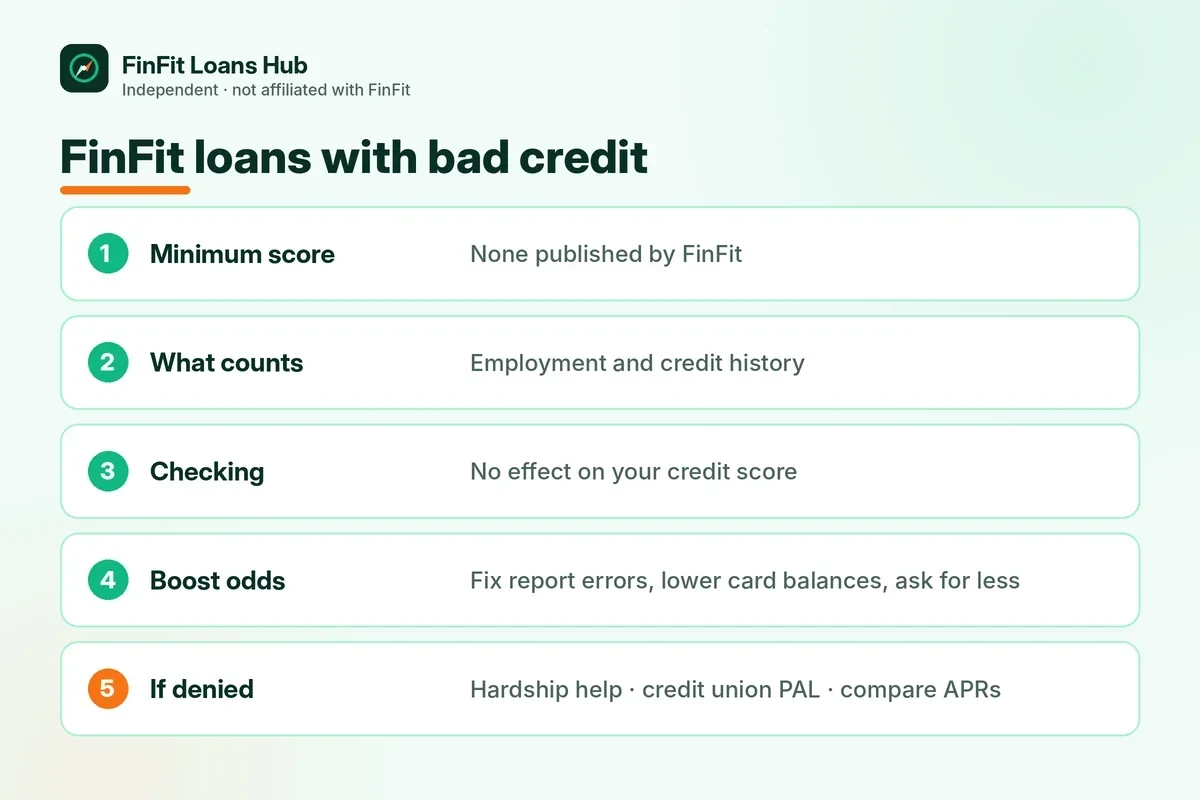
- FinFit loans have no published minimum credit score; FinFit weighs employment and credit history.
- Checking your offer doesn’t affect your credit score.
- No co-signers, one loan at a time, and personal/household uses only.
- If denied, try employer hardship help or a credit union PAL before high-cost lenders.
The short answer: possibly, yes
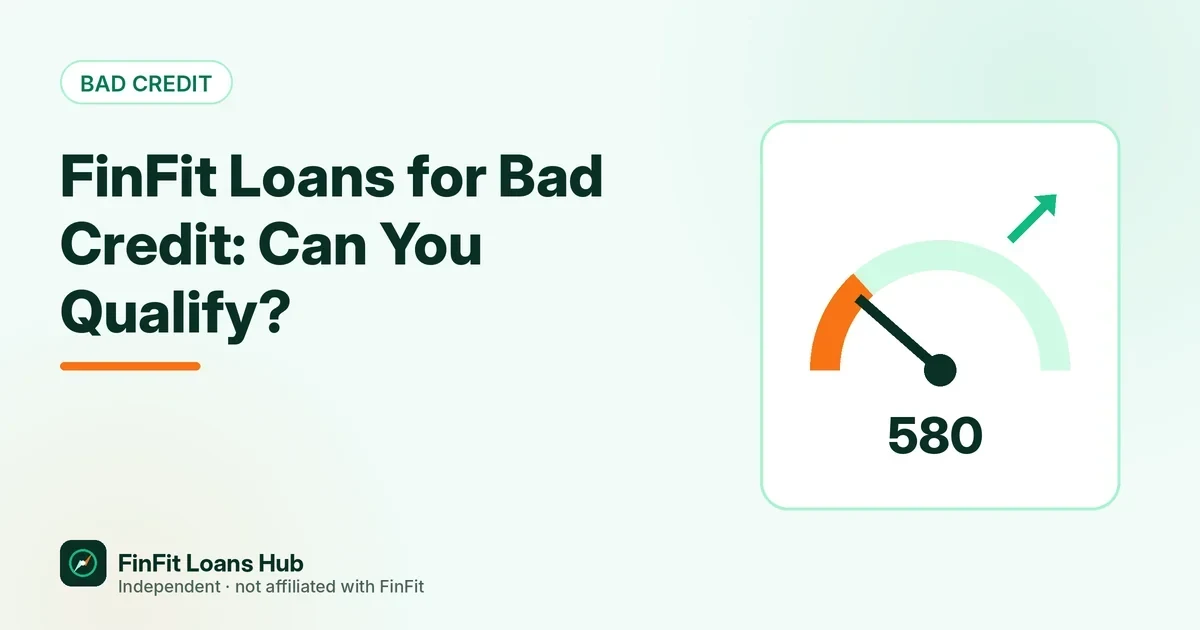
FinFit loans don’t come with a published minimum credit score. FinFit says it prices loans based on your employment and credit history, and that because of its employer partnerships, some people who may not qualify with traditional lenders can still receive an offer. Approval is never guaranteed — every loan is subject to credit approval — but a low score alone isn’t an automatic “no.”
Two things work in your favor if your credit is bruised. First, checking your FinFit offer doesn’t affect your credit score, so you can find out where you stand without a penalty. Second, FinFit reports repayment history to the credit bureaus, which means an approved FinFit loan can become a tool for rebuilding.
Remember: FinFit loans are only available through participating employers. If your job doesn’t offer FinFit, skip to your other options.

How FinFit decides on FinFit loans for bad credit
FinFit obtains consumer reports on applicants and sets a fixed rate based on what it sees. Its published process has five stages: you submit an application, your information is verified, the loan is approved or denied, you sign the contract, and funds are issued. A few rules apply to everyone, whatever their score:
- No co-signers: FinFit doesn’t accept joint applications.
- One loan at a time: an open FinFit loan must be repaid before you can apply again.
- Allowed uses: personal, family, or household needs only — not real estate, business, securities, or college costs.
- State rules: product availability and features vary by state.
Because the rate reflects your history, a weaker profile may mean a higher APR than someone with excellent credit. That’s why it pays to read the offer closely and compare it before you sign.
Why employer loans like FinFit loans can work for bad credit
Traditional lenders lean heavily on credit scores because they have little else to go on. Employer-sponsored programs have something extra: a connection to your paycheck. Repayment usually comes straight out of payroll, which makes on-time payment the default rather than something you have to remember. That structure is a big reason employer programs can consider applicants that a bank might turn away.
It also works in your favor after approval. Payment history is the single most important ingredient in most credit scores, and automatic payroll payments make it easier to build an unbroken on-time record. Read how FinFit loans affect your credit score for the full picture.
How to improve your odds of approval for FinFit loans
- Pull your free credit reports first. Errors are common. Disputing a wrong late payment or an account that isn’t yours can help before you apply.
- Bring down card balances if you can. Lower utilization can improve your profile quickly.
- Ask for less. A smaller amount is easier to approve and cheaper to repay. Read how much you can borrow with FinFit loans.
- Pay off any open FinFit loan first. You can only hold one at a time.
- Keep your employment details consistent. FinFit verifies your information, so make sure what you enter matches HR records.
Bad-credit borrowing options compared
| Option | Typical cost signal | Builds credit? | Best for |
|---|---|---|---|
| FinFit loans | Fixed APR disclosed before signing | Yes, reported to bureaus | Employees with FinFit at work |
| Credit union PAL | APR capped at 28%; app fee up to $20 | Varies by credit union | Credit union members needing $200–$2,000 |
| Secured credit card | Deposit sets your limit | Usually yes | Rebuilding with small, planned purchases |
| Payday loan | About $15 per $100 — almost 400% APR for two weeks | Usually not | Avoid if at all possible |
Sources: FinFit FAQ; NCUA PAL rules; CFPB. On mobile, swipe the table sideways.
If you’re denied FinFit loans (or don’t have FinFit)
A denial isn’t the end of the road. Lenders must tell you why credit was denied, which gives you a roadmap. Then work through these, roughly from cheapest to most expensive:
- Employer hardship programs or payroll advances, if your company offers them.
- Credit union payday alternative loans, which the NCUA caps at 28% APR.
- Payment plans directly with the hospital, utility, or repair shop.
- Online lenders and partner networks — compare APRs carefully. You can check options from our partner network for free.
What to avoid when your credit is bad
“No credit check” offers are often the most expensive. The CFPB notes a common payday fee of $15 per $100 borrowed, equal to an APR of almost 400% on a two-week loan. Title loans add the risk of losing your car. And any lender asking for an upfront fee, gift cards, or a wire transfer before funding is a red flag. A slightly slower, cheaper option almost always beats a fast, expensive one.
A 90-day plan to strengthen your FinFit loans application
If you don’t need the money today, a few weeks of preparation can improve both your approval odds and the rate you’re offered. Here’s a realistic schedule:
| When | Focus | Actions |
|---|---|---|
| Days 1–7 | Know your starting point | Pull your free reports from all three bureaus; list every account, balance, and late payment |
| Days 8–30 | Clean up errors | Dispute anything inaccurate with the bureau reporting it; keep copies of letters and proof |
| Days 31–60 | Lower utilization | Pay revolving balances down, starting with cards closest to their limits; avoid new credit applications |
| Days 61–90 | Apply smart | Check your FinFit offer (no score impact), request the smallest amount that solves the problem, and compare the APR |
On mobile, swipe the table sideways. Timelines are illustrative; credit bureaus generally investigate disputes within about 30 days.
The biggest wins usually come from two places: correcting errors that shouldn’t be there and lowering card balances. Neither requires taking on new debt.
How to read a denial for FinFit loans
If a lender turns you down based on information in your credit report, federal law requires it to tell you. That notice should name the credit bureau that supplied the report, and you’re entitled to a free copy of that report if you request it within 60 days. Use it. The reasons listed — for example, “too many recent inquiries” or “high balances relative to limits” — are a to-do list for your next application.
A denial for FinFit loans doesn’t follow you to other lenders as a “mark” on your report. What other lenders may see is a hard inquiry, but FinFit says a hard inquiry appears only if you’re approved and accept, so a FinFit denial itself won’t add one.
Bad-credit myths that cost borrowers money
- “With bad credit, I can only get payday loans.” Not true. Employer programs like FinFit loans, credit union PALs, and secured cards are all designed with imperfect credit in mind.
- “Checking my rate will lower my score.” Not with FinFit: applying doesn’t affect your score.
- “Paying off a loan early hurts my credit.” A paid-in-full loan with on-time history is a positive record, and FinFit charges no prepayment penalty.
- “Closing old cards will help.” Often the opposite — closing cards can raise your utilization and shorten your credit history.
- “No credit check means no risk.” No-credit-check loans tend to carry the highest costs, often with a lump-sum due date that’s hard to meet.
Frequently asked questions about FinFit loans
What credit score do I need for FinFit loans?
FinFit doesn’t publish a minimum score. It considers employment and credit history, and says some applicants who may not qualify with traditional lenders can still get an offer.
Can I get FinFit loans with a co-signer?
No. FinFit doesn’t accept joint applications.
Does checking FinFit loans hurt bad credit further?
No. FinFit says applying doesn’t affect your credit score. A hard inquiry appears only if you’re approved and accept.
Will FinFit loans help rebuild bad credit?
They can. FinFit reports repayment history to the credit bureaus, so on-time payroll payments add positive history over time.
What if I'm denied FinFit loans?
Review the reasons provided, check your credit reports for errors, and consider employer hardship help, a credit union PAL, or carefully compared offers from other lenders.
Sources (5)
- FinFit — Frequently Asked Questions (FinFit member FAQ, accessed November 2026)
- FinFit — Personal Loan / Debt Consolidation Loan page (accessed November 2026)
- National Credit Union Administration — Payday Alternative Loans (PALs I and PALs II) rules
- Consumer Financial Protection Bureau — “What are the costs and fees for a payday loan?”
- AnnualCreditReport.com — Free credit reports (authorized by federal law)
More guides on FinFit loans

FinFit Loans and SafetyNet: Turning Loan Payments into Emergency Savings
Read article →
FinFit Loans and Your Credit Score: Inquiries, Reporting & Rebuilding
Read article →