Key takeaways: FinFit loans repayment
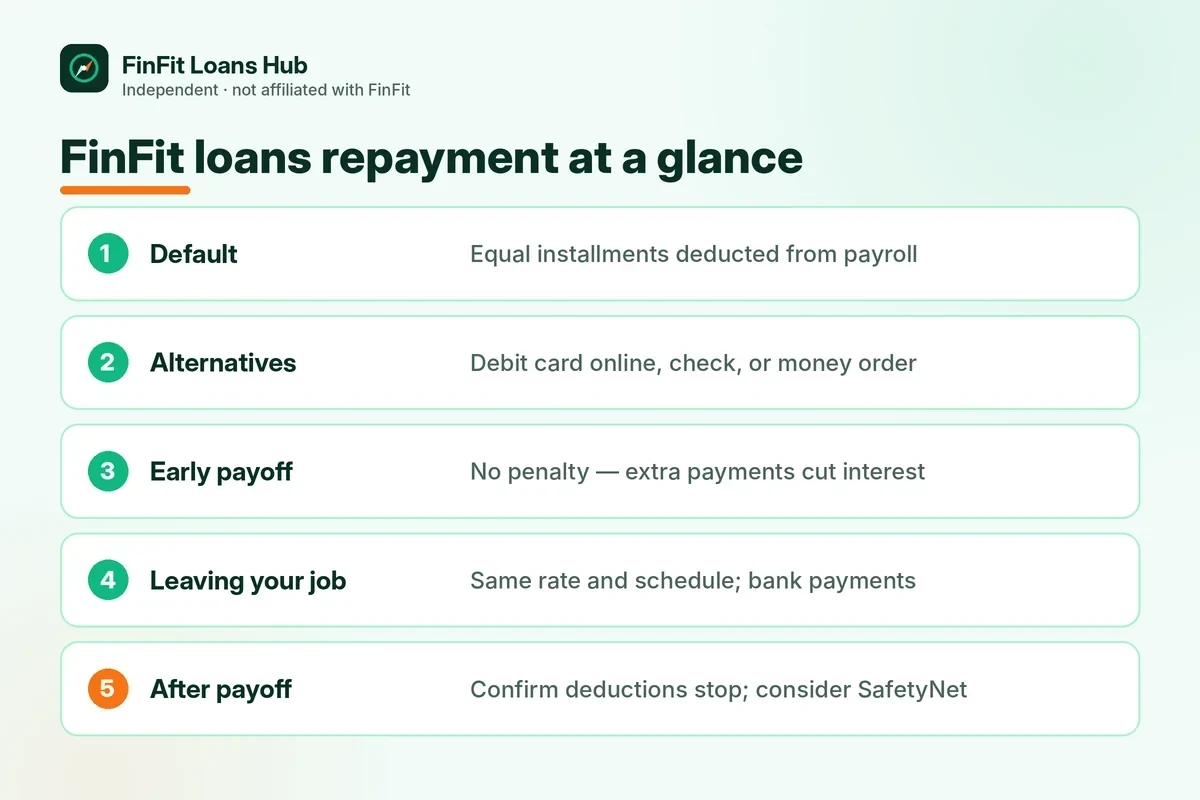
- FinFit loans are repaid in equal installments, usually straight from payroll.
- You can opt out and pay by debit card, check, or money order.
- There’s no prepayment penalty; extra payments shorten the loan and cut interest.
- If you leave your job, your rate and schedule stay the same — set up bank payments first.
How payroll repayment works for FinFit loans
By default, FinFit loans are repaid in equal installments deducted from each paycheck through your employer’s payroll. Your rate is fixed for the life of the loan, so the payment amount doesn’t change. That predictability is the core advantage: once the deduction is set, on-time payments happen automatically, and FinFit reports that repayment history to the credit bureaus.
The trade-off is a slightly smaller paycheck until the loan is paid off. Before you accept an offer, check that your take-home pay after the deduction still covers rent, food, transportation, and other essentials.

Other ways to repay FinFit loans
Payroll deduction is optional. FinFit says you can opt out and instead:
- Pay by debit card online, or
- Mail a check or money order.
If you switch, set calendar reminders for every due date — you lose the “automatic” safety net that makes on-time payment easy.
Paying off FinFit loans early: how much you can save
FinFit states there are no fees or penalties for paying early, and extra payments reduce the total interest you pay. Extra payments don’t lower your scheduled payment; they shorten the loan and cut interest. Here’s an illustrative example:
| $2,000 at 20% APR, 12 months | Months to pay off | Total interest |
|---|---|---|
| Scheduled payments only ($185.27/mo) | 12 | $223.23 |
| Scheduled payment + $50 extra each month | 10 | $174.95 |
Illustrative math with standard amortization and no fees; your FinFit loans terms may differ.
Adding $50 a month saves about $48 and two months of payments in this example. Even a one-time extra payment from a tax refund or bonus helps.
What happens to FinFit loans if you leave your job
This is one of the most borrower-friendly parts of FinFit loans. FinFit says your rate and payment schedule stay the same after you leave your employer. Payments switch to automatic withdrawals from your bank account — if you authorized that when you applied. If you didn’t, contact FinFit support right away to set up direct payments.
Job-change checklist for FinFit loans
- Before your last day, confirm your remaining balance and next due date in your FinFit dashboard.
- Confirm whether bank auto-payments are authorized; if not, set them up.
- Check your final paycheck to see whether a loan deduction was taken.
- Watch your bank account on the first due date after you leave.
Your final-payment checklist
A few BBB reviewers reported payroll deductions continuing after a loan was paid off. A little follow-up prevents that:
- When the balance reaches zero, save a screenshot or confirmation of payoff.
- Ask FinFit and payroll to confirm the deduction has been stopped.
- Check your next two pay stubs. If a deduction appears, request a refund in writing with dates and amounts.
- Decide whether to keep the same amount going into savings through SafetyNet — here’s why that’s smart.
- Remember: you can only have one FinFit loan at a time, and personal loans aren’t eligible for refinancing, so plan any future borrowing around your payoff date.
If you’re struggling to repay FinFit loans
Act early. Contact FinFit’s Account Management team before a payment is missed, explain what changed, and ask what options are available. Review your budget for expenses you can pause, and look at whether a hardship program at work could help. Don’t ignore the problem — missed payments can be reported to the credit bureaus and undo the progress on-time payments have built.
How FinFit loans payments appear on your pay stub
Once your loan is funded, you should see a new deduction line on your pay stub. Employers label it differently — it may say “FinFit,” “loan repayment,” or a similar description. Check three things on the first stub after funding:
- The amount matches the installment in your loan agreement.
- The timing matches the first payment date in your schedule.
- Your net pay still covers your essentials.
Keep your stubs until the loan is paid off. If there’s ever a dispute about whether a payment was made, they’re your best evidence.
Budgeting around a FinFit loans deduction
Here’s a simple way to think about it. Suppose your take-home pay is $1,600 every two weeks and your FinFit loans deduction is $85. That’s about 5.3% of each paycheck. Before you accept, ask:
- After the deduction, do rent or mortgage, utilities, food, transportation, and minimum debt payments still fit?
- Is there anything left for small surprises, even $20?
- Will any other deduction start or rise during the loan (for example, benefits enrollment changes)?
If the answer to any of these is “no,” consider a smaller amount or a longer term. A slightly longer term costs more interest overall, but a payment you can always make is better than one you might miss. See how much to borrow with FinFit loans.
Should you pay off FinFit loans early or build savings first?
Both are good moves; the right order depends on your situation:
- If you have no emergency cushion at all, building a small buffer (even a few hundred dollars) can keep the next surprise from turning into another loan.
- If you already have a cushion, extra payments on FinFit loans save interest with no prepayment penalty.
- If your FinFit APR is high relative to what savings earn, paying down the loan usually wins once a basic buffer exists.
Many borrowers split the difference: a small automatic savings transfer plus an occasional extra loan payment from tax refunds or bonuses.
FinFit loans repayment vs. other ways to borrow
How a loan is repaid matters as much as what it costs. Compared with common alternatives, FinFit loans repayment is designed to keep you on track:
| Option | How you repay | What it means for you |
|---|---|---|
| FinFit loans | Equal installments, usually from payroll | Predictable; balance falls every pay period |
| Payday loan | Full balance plus fee on next payday | Large single hit; rollovers add fees |
| Earned wage access | Advance taken from next paycheck | Smaller next paycheck; easy to repeat |
| Credit card | Minimum payment, balance can revolve | Flexible, but interest can linger for years |
On mobile, swipe the table sideways.
The common thread: options with a fixed end date and equal payments are easier to finish. That’s why the structure of FinFit loans repayment is one of its strongest features in our FinFit loans review.
Frequently asked questions about FinFit loans
How are FinFit loans repaid?
By default, in equal installments deducted from your paycheck. You can opt out and pay by debit card online or by mailing a check or money order.
Can I pay off FinFit loans early?
Yes. FinFit says there are no fees or penalties for early repayment, and extra payments reduce total interest.
What happens to FinFit loans if I quit?
FinFit says your rate and schedule stay the same. Payments move to automatic bank withdrawals if you authorized them; otherwise, contact FinFit support to set up payments.
Can I refinance FinFit loans?
Not currently. FinFit says its personal loans aren’t eligible for refinancing, and you can have only one loan at a time.
What if payroll keeps deducting after I pay off my FinFit loan?
Contact FinFit and your payroll department right away, provide your payoff confirmation and pay stubs, and request a written refund timeline.
Sources (4)
- FinFit — Frequently Asked Questions (FinFit member FAQ, accessed November 2026)
- FinFit — Personal Loan / Debt Consolidation Loan page (accessed November 2026)
- Better Business Bureau — FinFit, LLC customer reviews profile (Virginia Beach, VA)
- 401(k) Specialist — “FinFit Launches Safety Net Solution”